Loading…
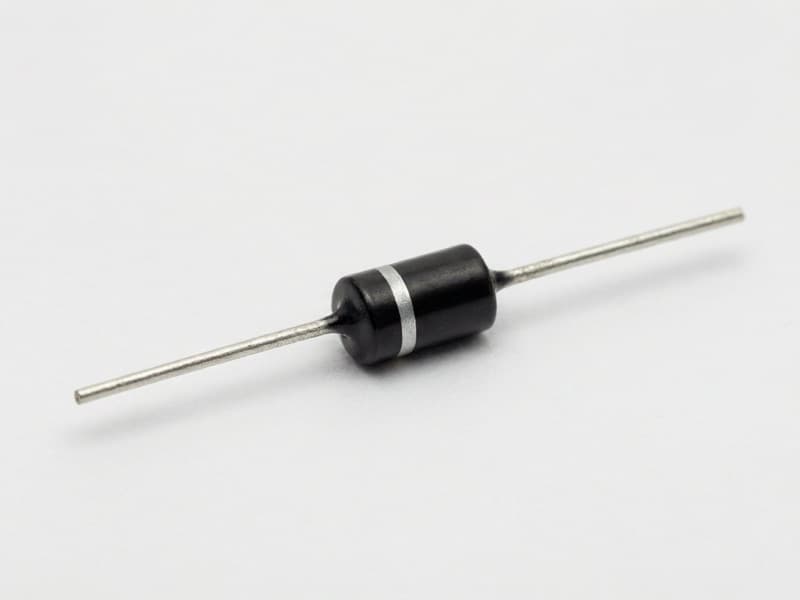
DO-41 · 1N4007
ActiveGeneral-Purpose Rectifier (1kV/1A)
1N4007
Vishay · DO-41 · General-Purpose Rectifier (1kV/1A)
Price on Request
Get a competitive quote within 24 hours. Volume discounts available. Shenzhen stock ships in 1-2 business days.
Overview
The 1N4007 is the 1000 V ceiling of the JEDEC-registered 1N400x rectifier family: a planar, glass-passivated silicon PN junction in the DO-41 (DO-204AL) molded epoxy axial package with matte-tin leads and a cathode band, weighing 0.33 g. Because the 1N4001 through 1N4007 differ only in reverse voltage, most board houses standardize on the 1N4007 and delete the lower-voltage lines from the BOM — one reel covers 12 V adapters, 230 VAC mains bridges, relay clamps and reverse-polarity protection alike.
Vishay specifies 1.0 A average forward current at 0.375 inch (9.5 mm) lead length and TA = 75 °C, not at room temperature, so the derating curve — not the headline number — sets your real design margin. Maximum instantaneous forward voltage is 1.1 V at 1.0 A, reverse leakage is 5.0 µA at 25 °C rising to 50 µA at 125 °C, surge capability is 30 A for an 8.3 ms half sine (45 A for a 1 ms square pulse), the I²t fusing rating is 3.7 A²s, junction capacitance is 15 pF at 4 V and 1 MHz, and thermal resistance is 50 °C/W junction-to-ambient or 25 °C/W junction-to-lead with a 150 °C maximum junction.
Recovery is the parameter people get wrong. Vishay does not publish a trr for this family because it is a standard-recovery rectifier; measured reverse recovery is on the order of tens of microseconds (commonly quoted as roughly 30 µs). That is invisible at 50 Hz or 60 Hz, but in a converter switching above a few kilohertz the stored charge turns into switching loss, reverse-recovery current spikes and radiated EMI. Where the diode commutates at switching frequency, use the FR107 (500 ns), the UF4007 (75 ns) or a Schottky such as the 1N5819 or SS34 instead.
Commercially the 1N4007 is a true commodity: Vishay ships it as 1N4007-E3/54 (5,500 pcs on a 13 inch tape-and-reel) and 1N4007-E3/73 (3,000 pcs ammo pack), and onsemi, Diodes Incorporated, STMicroelectronics, MCC, Rectron and dozens of Asian fabs produce pin-compatible parts at fractions of a cent in volume. Counterfeiting is less lucrative than for ICs but still common in two forms: lower-voltage members relabeled as 1N4007, and small-die clones that pass a DC check and fail on surge. Screen lots by applying 1000 V reverse and measuring leakage, checking body length (5.2 mm max) and weight, and confirming the marking is laser-etched rather than printed ink.
Key Features
- 1000 V VRRM and 700 Vrms — the highest-voltage member of the 1N400x family
- 1.0 A average forward current at 9.5 mm lead length and TA = 75 °C
- 30 A non-repetitive surge (8.3 ms half sine) with a 3.7 A²s fusing rating
- Standard recovery (~30 µs typical): for line frequency, not for SMPS commutation
- Multi-sourced: Vishay, onsemi, Diodes Inc, ST, MCC, Rectron and Asian fabs
Typical Applications
- Mains input bridge and half-wave rectifiers up to 230 VAC
- Freewheeling / flyback across relay coils, contactors and solenoids
- Reverse-polarity and back-EMF protection on 12 V to 24 V rails
- Heater, fan and motor supplies in appliances and white goods
- High-voltage multiplier stacks for laser, ionizer and CRT supplies
- Snubber and clamp networks in motor drives and welding equipment
Specifications
- Repetitive Peak Reverse Voltage (VRRM)
- 1000 V
- RMS Reverse Voltage (VRMS)
- 700 V
- Average Forward Rectified Current (IF(AV), 9.5 mm Lead Length, TA = 75 °C)
- 1.0 A
- Peak Forward Surge Current (IFSM, 8.3 ms Half Sine)
- 30 A
- Maximum Instantaneous Forward Voltage (VF at 1.0 A)
- 1.1 V
- Maximum DC Reverse Current (IR at 25 °C, Rated VDC)
- 5.0 µA
- Reverse Recovery Time (Standard Recovery, Typical)
- 30 µs
- Operating Junction Temperature
- -50 to +150 °C
- Pins
- 2
- RoHS
- Compliant
Procurement Tips
Collapse your 1N400x BOM lines onto the 1N4007 to cut reel changes, but always write the full vendor part number (for example Vishay 1N4007-E3/54) on the BOM so the assembler cannot substitute a small-die clone with weaker surge performance.
Frequently Asked Questions
What is the difference between 1N4007 and 1N4001?
Only the reverse voltage: 1N4001 is 50 V, 1N4004 is 400 V, 1N4007 is 1000 V. Forward current (1.0 A), forward drop (1.1 V at 1 A), surge (30 A) and the DO-41 package are identical, so a 1N4007 can always replace a lower-voltage member — never the other way round.
Can I use a 1N4007 in a switching power supply?
Not where it commutates at switching frequency. It is a standard-recovery part with roughly 30 µs of recovery, so the stored charge produces losses and EMI above a few kilohertz. Use the FR107 (500 ns), UF4007 (75 ns) or a Schottky such as 1N5819 / SS34 for the switching node. The 1N4007 is still fine for the slow mains bridge ahead of the converter.
1N4007 versus 1N4148 — are they interchangeable?
No. The 1N4148 is a 100 V, 200 mA signal diode with 4 ns recovery; the 1N4007 is a 1000 V, 1 A rectifier with microsecond-scale recovery. Use the 1N4148 for clamping, steering and small-signal duty, and the 1N4007 where current or reverse voltage demand it.
Why does my 1N4007 run hot at well under 1 A?
Conduction loss is VF x IF, so at 0.8 A it dissipates about 0.8 W. With 50 °C/W junction-to-ambient on a small pad that is already a 40 °C rise, and the 1.0 A rating only applies at 75 °C lead temperature with 9.5 mm of lead on copper. Add copper area and airflow, or move to a 3 A part such as the 1N5408.
How does reverse leakage behave at temperature?
Vishay guarantees 5.0 µA maximum at rated DC blocking voltage and 25 °C, and 50 µA at 125 °C. Leakage roughly doubles every 10 °C, which matters in high-voltage multiplier stacks and precision dividers — budget for the hot value, not the room-temperature one.
Can I series-connect two 1N4007 for 2000 V?
Only with balancing: a high-value resistor (typically 100 kΩ to 1 MΩ) across each diode for static sharing plus small capacitors for dynamic sharing during recovery, because leakage and trr vary device to device. For a clean design, buy a single higher-voltage rectifier instead.
How do I spot a remarked or undersized 1N4007?
Apply 1000 V reverse on a curve tracer or hipot fixture and measure leakage (genuine parts stay near the 5 µA limit at 25 °C), verify the DO-41 body is within 4.1 to 5.2 mm long and about 0.33 g, look for laser rather than ink marking, and inspect lead plating for uniform matte tin. We sample-test every reel we ship.
What are the MOQ and lead times?
MOQ is one reel of 5,500 pcs (Vishay 1N4007-E3/54) or 100 pcs loose for prototyping and repair. Shenzhen stock ships in 1 to 2 business days; authorized Vishay channel replenishment runs 4 to 8 weeks.
Alternatives & Equivalents
1N4148
Nexperia
alternative
1N5819
Vishay
alternative
FR107
Diodes Incorporated
alternative
KBPC5010
Diodes Incorporated
companion
Need 1N4007 pricing and availability?
Submit an RFQ — we reply within 24 hours with stock, pricing, lead time and packaging options.
Request a Quote →